Mumbai and Bengaluru pay the highest salaries in the country, and take a big share of it straight back in rent. Here's what that trade does to your net worth.
Two engineers, same age, same company, same CTC. One is based in Mumbai, one in Hyderabad. Five years in, their net worth can differ by 30 to 40 percent, and it has almost nothing to do with how well either of them invests.
City is one of the most underrated variables in net worth, because salary numbers get all the attention while cost of living quietly decides how much of that salary ever becomes an asset.
There is no government dataset that measures net worth city by city. The All India Debt and Investment Survey (AIDIS), run by India's National Statistical Office, gives only a rural-urban split, last measured in 2018. What follows instead is a directional model built from published 2026 salary benchmarks (compensation surveys aggregated by recruiters and HR platforms) and cost-of-living indices for rent, the single biggest swing factor in monthly savings rate.
Read this as relative positioning, not precision. Individual results vary enormously by sector, seniority, and whether you own or rent. The value here is in the pattern, not the decimal point.
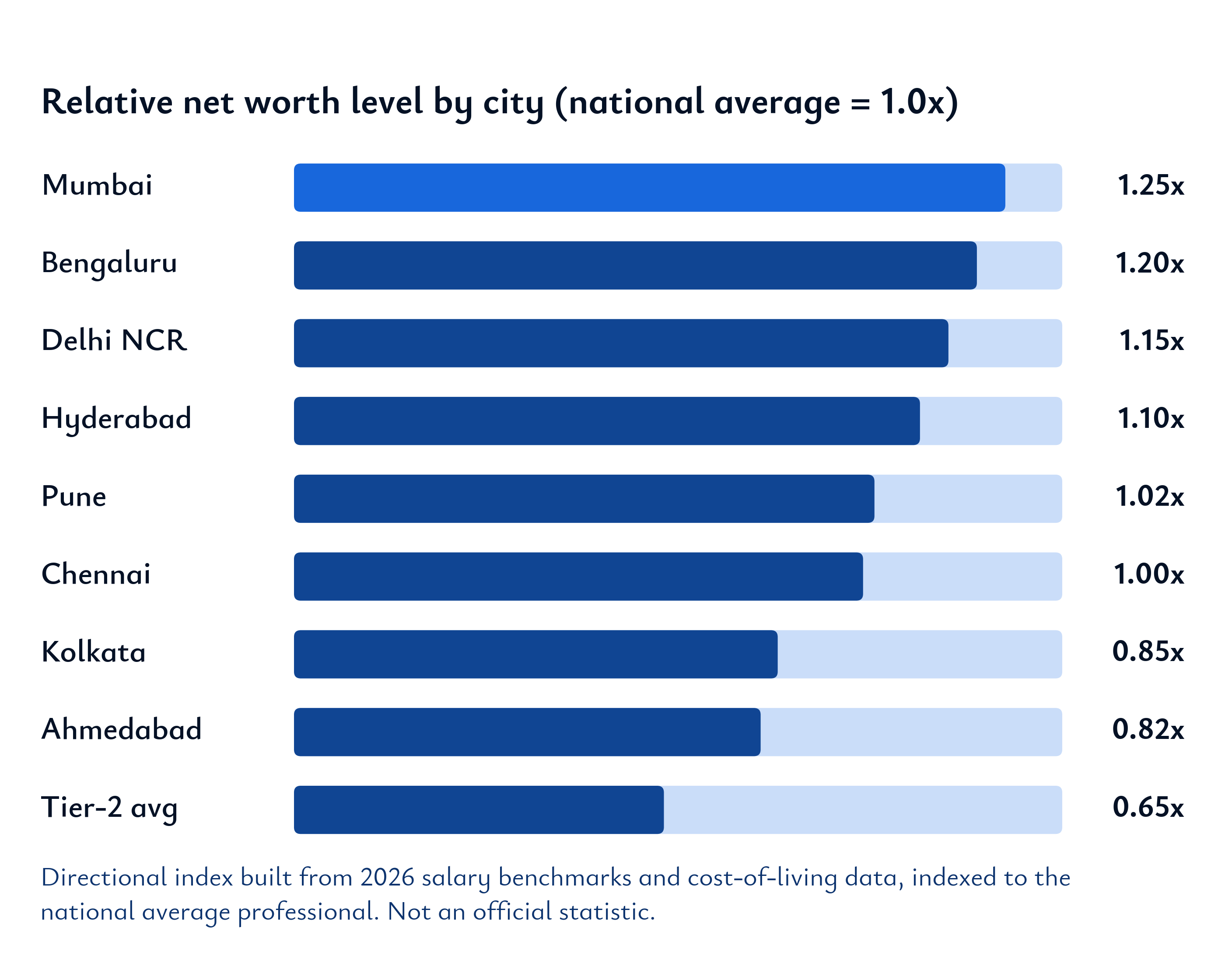
Mumbai and Bengaluru sit at the top of that chart because of what people there already hold, mostly property. It says nothing about how fast someone renting a flat in either city is adding to their number today. That is a very different question, and the answer runs the other way.
Mumbai carries the country's highest salaries in finance and media, and its property has appreciated enough that Mumbai households often show the highest net worth figures in the country on paper. But a one-bedroom flat in central Mumbai can run upward of ₹60,000 a month, nearly double the equivalent in Bengaluru and close to triple Delhi NCR or Gurugram. For a salaried professional who doesn't already own property, that single line item can erase the salary advantage entirely before a rupee reaches a mutual fund.
Bengaluru pays the most for tech talent in India, typically 15 to 20 percent above the national average, and often 20 to 25 percent above at entry level. Hyderabad tends to pay 5 to 10 percent less for comparable roles, but rent runs 30 to 40 percent lower. For an engineer early in their career, that gap in living cost can matter more than the gap in salary. Hyderabad frequently comes out ahead on disposable income even with a smaller headline number.
Rent for a 1BHK in the tech corridor, against salary vs the national average:
Tier-2 salaries are lower, often 20 to 40 percent below a tier-1 city for the same role. But because rent and everyday costs fall even further, a larger share of every rupee earned is available to invest. Combined with remote work, this has created a real arbitrage: earning a Bengaluru-level salary while paying Indore or Coimbatore living costs is now one of the fastest ways to build net worth in your twenties, if the role allows it.
See how your city changes your number
FOLO benchmarks your net worth against your age group and city cost profile automatically, once your accounts are connected.
There's no official city-wise net worth dataset. Directionally, Mumbai households tend to show the highest figures due to property values and finance pay, followed by Bengaluru and Delhi NCR. But nominal net worth isn't the same as how fast someone is currently building it.
For most salaried tech professionals, Bengaluru tends to build net worth faster in the early and mid-career years, since tech pay sits close to Mumbai finance pay while rent runs roughly half.
Often, yes, especially with remote work. Tier-2 salaries run 20 to 40% lower than tier-1, but costs fall further still, leaving more of each rupee investable.
A great deal. Rent is usually the largest controllable monthly cost, 30 to 50% of take-home pay in a metro, and often decides investable surplus more than salary does.
Continue the series
FOLO is India's NetWorth app. Know your number, benchmark it, and watch it grow. Free, SEBI registered.
This article is for educational purposes and is not investment advice. Investment in securities market are subject to market risks.